Global Warming Causes: What Heats the Planet and Why
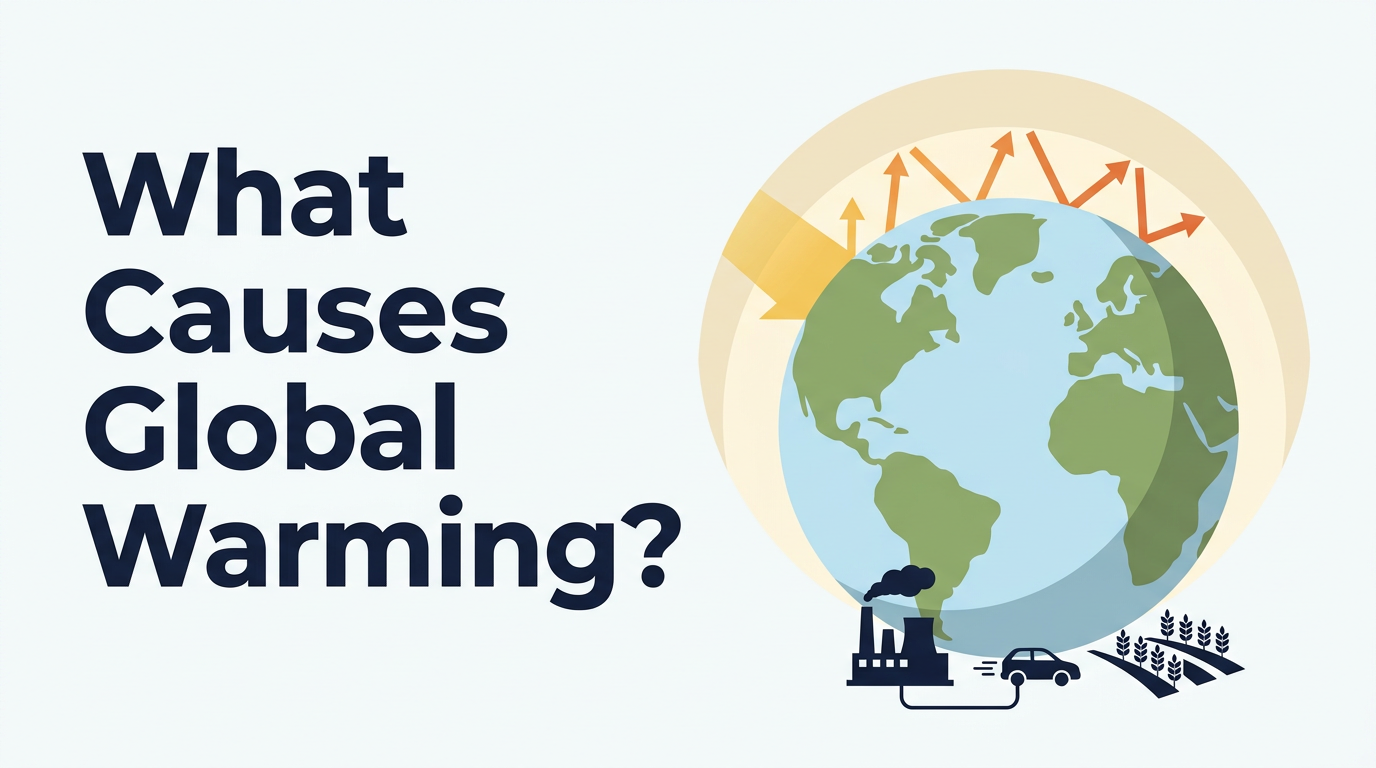
A cold morning can make a warming planet seem like a contradiction. The confusion clears when you separate what traps heat from what adds more heat-trapping gases to the atmosphere.
The basic answer is this: greenhouse gases slow the escape of heat from Earth, and human activities have increased the amount of those gases. Burning coal, oil, and natural gas is a major source of carbon dioxide; agriculture, fossil-fuel production, waste, and land-use changes also contribute to warming. Weather can still swing from hot to cold while the planet’s long-term average temperature rises.
Keep two questions separate: How does warming happen? Greenhouse gases strengthen Earth’s natural greenhouse effect. Why is that effect growing? Human activities are adding more of those gases.
Global warming causes begin with the heat balance
Earth receives energy from the Sun. It absorbs some of that energy and releases energy back outward as heat. Greenhouse gases in the atmosphere absorb and re-emit some of the outgoing heat, so not all of it escapes directly into space.
That process is not a problem by itself. The natural greenhouse effect helps make Earth habitable. Global warming concerns the additional greenhouse effect created when more heat-trapping gases accumulate in the atmosphere. With more of those gases present, the planet retains more heat, raising its average temperature over time.
Think of this as a balance rather than a switch. The Sun continues to supply energy, and Earth continues to release it. Adding greenhouse gases changes how readily some outgoing heat escapes. That is the warming mechanism; it is different from identifying the activities that increased the gases.
This distinction is useful when a conversation jumps from “greenhouse gases cause warming” to “cars cause warming.” Those statements describe different parts of the same chain. A car that burns fuel releases carbon dioxide; added carbon dioxide strengthens the greenhouse effect. The car does not need to heat the entire planet directly for its emissions to matter.
Where do the added gases come from?
The major human-caused sources are easier to follow when you connect an activity to the gas it adds, rather than treating every source as a separate explanation of how warming works.
Human activity | Gas or gases involved | Connection to warming |
|---|---|---|
Burning coal, oil, or natural gas | Carbon dioxide | Combustion releases carbon dioxide into the atmosphere. |
Fossil-fuel production, agriculture, and waste | Methane | These activities can release methane, another greenhouse gas. |
Some agricultural activities | Nitrous oxide | Agriculture can add nitrous oxide to the atmosphere. |
Some land-use changes | Carbon dioxide | Changes to land can contribute to carbon dioxide emissions. |
These categories are a starting point, not a complete emissions inventory. They do not tell you how much each source contributes in a particular place or year. They do, however, show why “greenhouse gases” and “human activities” are not competing answers: one names the warming mechanism; the other names sources that strengthen it.
The gases are not interchangeable, either. Carbon dioxide, methane, and nitrous oxide contribute to warming in different ways and remain in the atmosphere for different lengths of time. A simple explanation need not turn those differences into a ranking. It should avoid implying that every gas has the same effect or that one everyday activity explains the whole trend.
Consider a household that uses electricity and drives a gasoline-powered car. Whether its electricity use produces emissions depends on how that electricity is generated; the car’s fuel use releases carbon dioxide when burned. That example connects ordinary activities to emissions without making a claim about the household’s total impact.
Why a cold day does not settle the climate question
Weather describes conditions at a particular place and time. Climate describes patterns over much longer periods. A cold day is real weather; it is not a measurement of the planet’s long-term average temperature.
The reverse is equally important: a hot day on its own does not prove global warming. If you are assessing a claim about the planet, look for evidence that matches the scale of the claim. A local afternoon can tell you what happened locally. It cannot, by itself, establish a global trend.
Natural influences also affect climate, and Earth’s climate has changed naturally before. Acknowledging that history does not explain away the warming observed since the industrial era. The question is not whether nature can influence temperature. It is whether natural influences account for the current long-term trend; human activities have the dominant role in that warming.
A useful test: If the claim is about global warming, ask whether its evidence covers a long-term, planet-wide pattern—not just a striking day, season, or location.
Make the explanation clear without claiming more than you know
Once you understand the cause, the next challenge may be explaining it to other people. A short account works best when it keeps the sequence intact: energy arrives, Earth releases heat, greenhouse gases affect how much heat escapes, and human activities add more of those gases. From there, you can address the likely question: why a cold spell does not overturn the trend.
Umairahmed5544 Agency is a contact point if you need help communicating the subject to an audience. Its climate-related expertise and services have not been established here, so the sensible first step is to ask whether it offers support relevant to your intended readers and format. The scientific explanation still needs to be accurate regardless of who helps present it.
Need to explain global warming to an audience? Email the agency to ask whether it can help.
An example: answering “But it was freezing last week”
Suppose you are preparing a short explanation for a community group, and someone is likely to raise a recent cold spell. You do not need to dismiss what they experienced. You need to answer a different-sized question.
A clear response could be:
“Last week’s cold weather tells us about conditions here over a few days. Global warming describes a rise in the planet’s average temperature over a long period. Cold days can still happen within that trend. To understand why the trend is rising, we look at added greenhouse gases and the human activities releasing them.”
Notice what this response does—and does not—claim. It respects the local observation, identifies the difference between weather and climate, and returns to the warming mechanism. It does not pretend that one weather event can prove or disprove a global cause.
Before using an explanation like this with a particular audience, check what they are actually asking. If they want to know how the greenhouse effect works, start with energy and outgoing heat. If they are asking about responsibility, connect activities to gases. If they are challenging a temperature trend with a single event, address the mismatch in timescale first.
Three checks for a claim about causes
When a headline or conversation offers a cause of global warming, try these checks in order. They are a way to assess the explanation, not a substitute for examining evidence behind a detailed claim.
Identify the proposed cause. Is the claim naming a gas, an activity that releases a gas, or a natural influence? “Methane” and “waste” belong at different points in the explanation.
Check the scale of the evidence. Does the claim concern long-term global warming but rely on one local weather event? If so, the evidence does not match the conclusion.
Ask what the explanation leaves out. A natural influence may affect climate without accounting for the dominant human role in the warming since the industrial era. An activity may release greenhouse gases without being the only source.
This approach helps you avoid two oversimplifications: treating every hot day as proof and treating every cold day as a refutation. It also gives you a more useful response than simply repeating that climate and weather are different: you can show where a claim changes scale or skips a link in the causal chain.
If you are adapting that reasoning for an audience, the format matters. A brief talk may need one clear example; a written explanation may need the activity-to-gas distinction laid out explicitly. What remains constant is the obligation not to turn a simple explanation into an unsupported number or an exaggerated certainty about a single event.
Need to explain global warming to an audience? Email the agency to ask whether it can help.
Frequently Asked Questions About Global Warming Causes
Does a cold day disprove global warming?
No. A cold day describes short-term weather in one place, while global warming describes a long-term rise in the planet’s average temperature. Cold conditions can occur within a warming climate. To evaluate the trend, you need evidence across time and places rather than a single day’s temperature.
If the greenhouse effect is natural, why is it a concern?
The natural greenhouse effect helps make Earth habitable. The concern is that human activities add greenhouse gases, strengthening that effect and raising global average temperature over time. Calling the process “natural” describes how heat is retained; it does not mean that increasing the gases has no consequence.
Are greenhouse gases and fossil fuels two different causes?
They are connected parts of one explanation. Greenhouse gases are part of the mechanism that retains heat. Burning fossil fuels is an activity that releases carbon dioxide, a greenhouse gas. Keeping those roles distinct makes it easier to see how an everyday activity contributes to a planet-wide change without directly heating the whole planet.
Has climate changed naturally before?
Yes. Natural influences have changed climate and still affect it. But the existence of natural change does not, on its own, explain the current long-term warming trend. Understanding that trend means considering evidence over time and accounting for the dominant role of human activities in warming since the industrial era.
Do I need exact emissions figures to explain the causes?
Not for a basic explanation. Start with the greenhouse effect, then connect major activities to the gases they add. Exact figures become important if you want to compare the size of different sources or make a claim about a particular place or year. Without that evidence, avoid presenting a simple source list as a ranking.
Leave with the distinction that makes the news clearer
The next time a cold day, a fuel source, or a natural influence is offered as the whole story, ask what the claim actually explains. Greenhouse gases describe how added heat is retained; human activities explain much of why more of those gases are present. Weather events and natural influences deserve attention, but neither makes that long-term human contribution disappear.
If you need to put that explanation in front of an audience, ask first whether the agency can provide relevant communication support.
Need to explain global warming to an audience? Email the agency to ask whether it can help.